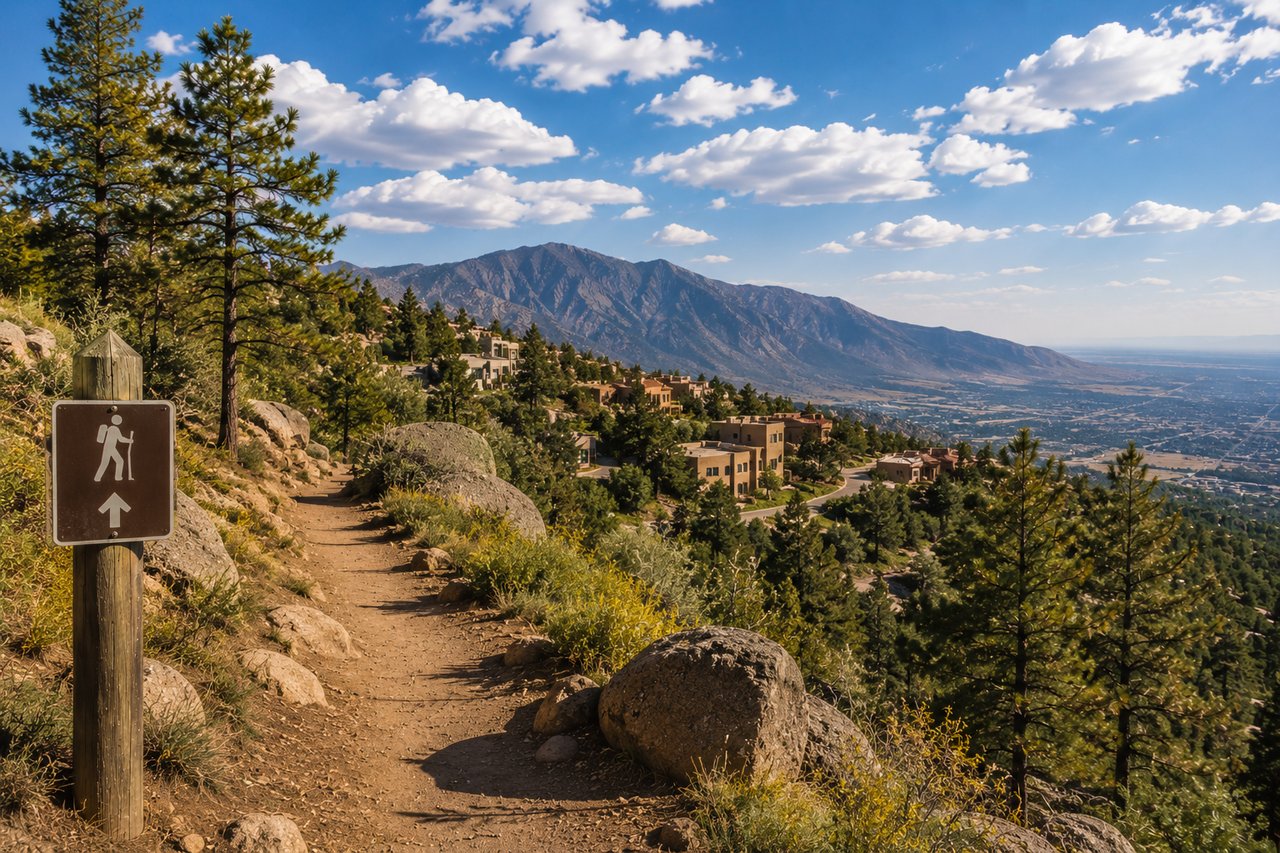
If you live in Sandia Heights, you've probably heard some version of this story from a neighbor by now: the Sandia Pueblo wants the mountain back, and if Congress goes along with it, the trails you've walked for years could get locked up. That's the headline version. It's also not quite what's on the table.
What's actually being proposed is narrower and, if you use these trails the way most Sandia Heights residents do, more relevant to how you use them than whether you can use them at all. The distinction matters, and almost nobody covering this story from outside the neighborhood has bothered to draw it clearly.
The Ten Thousand Acres Nobody Voted On
Sandia Heights is one of only two neighborhoods that directly border Elena Gallegos Open Space, the city land that feeds straight into the Sandia Mountain Wilderness, a fact that already put this neighborhood at the center of a fight over that land once before. In 2022, the city floated building an education center inside Elena Gallegos, and Sandia Heights' own homeowners association publicly opposed it, with then HOA president Roger Hagengruber writing directly to Mayor Tim Keller that a building would damage the natural setting the neighborhood was built around. A nonprofit called Save the Elena Gallegos later won a lawsuit over the project.
The current debate is a different fight over a larger stretch of the same mountain. The area in question is called the T'uf Shur Bien Preservation Trust Area, roughly 10,000 acres of the Sandia Mountain Wilderness along the range's west face, the same face Sandia Heights and Elena Gallegos sit against. Further south along that same face, reached off Forest Road 333 near the Juan Tabo Picnic Ground, the trust area includes La Luz Trail and Piedra Lisa Trail, the two trails named specifically in the current dispute.
This land has been under a specific arrangement since 2003, when Congress passed the T'uf Shur Bien Preservation Trust Area Act. That law protected the Pueblo's rights and interest in the area in perpetuity while also protecting, in the same breath, the public's longstanding use and enjoyment of it. The Forest Service has managed the land under that agreement for more than two decades.
Now the Pueblo wants that management moved. Sandia Pueblo Gov. Stuart Paisano has pointed to Forest Service budget cuts as the reason, describing ongoing vandalism, graffiti, trash, and abandoned vehicles on the land, along with trespassing near culturally significant sites, in comments reported by KRQE and the New Mexico Wildlife Federation. The proposed legislation would shift the trust area from the Department of Agriculture, which oversees the Forest Service, to the Department of the Interior, where it would be held for the Pueblo.
"Our cultural leaders are very concerned that there's a lot of trespassing."
That's Paisano, explaining the core complaint. Not that the trails exist. That people wander off them.
What Paisano Actually Said He'd Leave Alone
Here's the part that gets flattened in the shorthand version of this story. Paisano has been specific, on multiple occasions, about what would and wouldn't change if the transfer happens, though he's described the scope two different ways depending on the audience. Existing trails, roads, utilities, and hunting arrangements would stay in place, and La Luz and Piedra Lisa would remain with the Forest Service for maintenance, according to the New Mexico Wildlife Federation's account of his remarks to Sandoval County commissioners. In an interview with the Albuquerque Journal, Paisano said the Pueblo would only crack down on uses already banned inside a wilderness area, such as off-roading and mountain biking, both of which are already off limits everywhere on this mountain. But in his testimony to the county commission, he also described wanting to curb hikers, hunters, and rock climbers wandering off marked trails near sensitive sites, telling commissioners the goal was to control how many people wander into certain areas, per the New Mexico Wildlife Federation. Those are two different scopes, and which one ends up governing is the kind of detail that won't get settled until any legislation is actually written down.
Stays the same, per current statements | Gets tighter, per current statements |
|---|---|
Access to La Luz and Piedra Lisa trails | Off-roading and mountain biking, both already banned wilderness-wide |
Existing roads and utility access | Possibly, off-trail wandering near sensitive sites |
Hunting arrangements under the 2003 Act | Enforcement presence generally, which the Pueblo says has been thin |
If you're the kind of hiker who sticks to the marked trail, this proposal as currently described doesn't touch your Saturday morning, whether that's a lap through Elena Gallegos or a drive down to La Luz. If you're the kind of household that lets a dog range off-leash past the trailhead sign, or wanders past a rock cairn onto ground that isn't officially marked, that's the behavior Paisano has singled out. That's a real change for some hikers on this mountain. It's a different change than the one most headlines describe.
The Positions Already on Record
This isn't a two-sided story so much as a several-sided one, and the positions are already public:
- Sandoval County Commission approved a resolution supporting the transfer on June 24, 2026, though the Rio Rancho Observer notes the resolution doesn't decide anything on its own. The transfer still requires an act of Congress.
- U.S. Rep. Melanie Stansbury has staked out a middle position. She's said she supports strengthening the Pueblo's co-stewardship of the land with the Forest Service, but not transferring title away from the Forest Service or eliminating the area's wilderness protections, per KOB's coverage.
- Sen. Martin Heinrich and the New Mexico Wildlife Federation oppose the transfer outright. NMWF executive director Jesse Deubel has said the agency should be adequately funded rather than having the land moved out of Forest Service management, according to the Rio Rancho Observer.
- Gov. Michelle Lujan Grisham and NM Land Commissioner Stephanie Garcia Richard have both sent letters of support for the Pueblo's proposal.
- A resident group called Sandias for All formed specifically to push back and keep the land under Forest Service control, as described in KRQE's reporting.
- At a July 22 Sandoval County meeting, residents of Placitas and Corrales spoke against the county's support for the resolution, with one Corrales resident telling commissioners she'd cried on the drive over thinking about losing access, per the Rio Rancho Observer.
Nobody in this list is arguing that Piedra Lisa should close. The argument is over who decides what "use" means going forward, and whether a title transfer, once done, can be undone.
Why Nothing Changes This Week
The Pueblo has finished drafting the legislation, but it still hasn't been formally introduced in Congress, according to KRQE. A county commission resolution is a statement of support, not a legal mechanism. Congress has to act, and Congress hasn't yet had the chance to. If you're planning your fall hiking calendar around Elena Gallegos, the Pino Trail up to the Crest, or the drive down to La Luz, there's no reason to change it based on anything that's happened so far.
What's worth watching instead is the pace of federal legislation, which tends to be slow, and the tone of the public comment period, which has been anything but. This is very much a developing story, not a settled one.
The Maintenance Gap You Can Already See on Forest Service Road 333
Here's what's true regardless of how the legislative fight ends. The Forest Service's staffing and funding constraints on this stretch of mountain are already visible on the ground, not just in testimony. Potholes on Forest Service Road 333, the access route to some of the most-used trailheads in the trust area, and trash accumulating near trailheads have been cited directly by Pueblo leadership as evidence of the problem, per KRQE.
Volunteers have been filling part of that gap for years. Friends of the Sandia Mountains, a service organization that partners with the Forest Service on trail upkeep, reported that its Cibola Trail Rangers cleared 90 downed trees from Sandia trails in just the first six months of 2026. That's not a political statement about who should manage the land. It's a fact about who's actually out there doing the work right now, transfer or no transfer.
How to Follow It From Here
If you want to track this without waiting for the next news cycle, Friends of the Sandia Mountains posts updates as they happen, including links to the television coverage from the week the story broke in late July. Their Cibola Trail Rangers network, open to hikers, bikers, cross-country skiers, and equestrians who use the mountain regularly, shares real-time reports on trail conditions and, increasingly, on this debate. You can find both at friendsofthesandias.org.
Whatever Congress eventually does, the mountain behind your house isn't going anywhere. What changes is a question of enforcement at the margins, not access at the core, at least based on everything said publicly so far. That's worth knowing before you repeat the version of this story that's been flattened into a headline.
If you're weighing a move near the Sandia foothills and want a straight read on what a specific address means for trail access, HOA rules, or anything else particular to this pocket of Albuquerque, House of Homes NM is happy to talk it through. Let's Talk About Your Next Move.