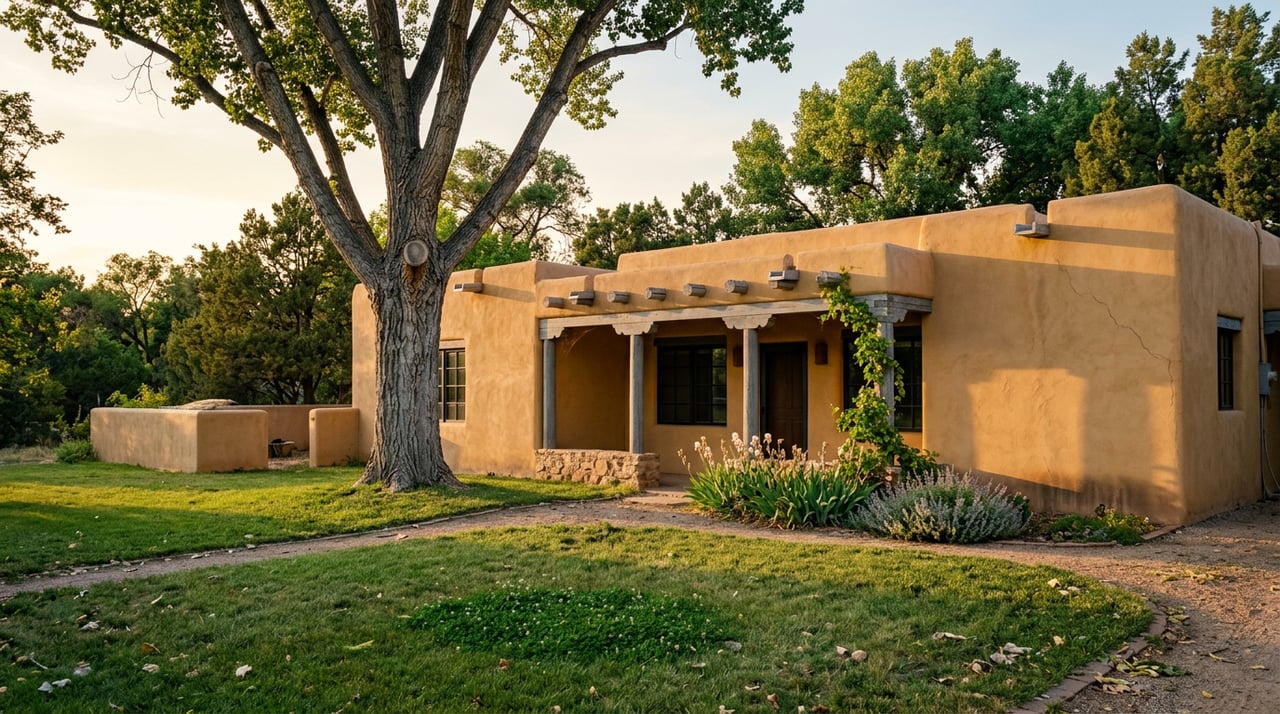
"The first day of spring marked a turning point," Jason Casuga said this year. As chief engineer of the Middle Rio Grande Conservancy District, he was explaining why the water feeding acequias from Corrales down through the North Valley had already dropped to a fraction of normal, weeks before most people plant a garden. For anyone touring a North Valley or Los Ranchos listing that mentions acequia frontage this summer, that sentence is worth sitting with. Casuga wasn't describing a bad season for farmers he'll never meet. He was describing the exact ditch some remodeled adobes and new-build lots are photographed beside, the one real estate copy calls a feature and MRGCD calls a shared, rationed resource.
Here's what almost never makes it into the listing description: a property backing an acequia does not automatically come with the right to use that water, and even when it does, the district that runs the system has said outright that deliveries in a dry year are not guaranteed. 2026 turned that warning into a live demonstration.
An Acequia Is a Ditch and a Membership, Not a Backyard Amenity
An acequia is both a physical irrigation channel and a community institution recognized in New Mexico law, with elected commissioners and a mayordomo who oversee maintenance and water deliveries. The people who hold shares in that system are called parciantes, and their rights are administered through the New Mexico Office of the State Engineer, separately from anything printed on a plat map.
That distinction matters because water running through a ditch along your property line is not the same as owning the right to use it. Whether a specific North Valley parcel actually carries a usable share depends on OSE records tied to that lot, deed language referencing a headgate or acequia membership, and whether the ditch itself is a main canal MRGCD maintains directly or a smaller lateral run by a local acequia association. The North Valley has both, and a listing rarely tells you which one borders the lot you're considering.
The Water Service Charge Nobody Mentions at the Open House
If a parcel has access to irrigation and MRGCD records consider it suitable for irrigation, the district assesses an annual Water Service Charge against it, whether or not the owner has ever irrigated a single plant. The district holds a reclassification hearing every September, when owners can protest that status and apply to reclassify a property as non-irrigable, or seek an exemption if there is no real access.
Unpaid charges do not just disappear at closing. MRGCD works with title companies to search for unpaid Water Service Charges before a sale goes through, and delinquent accounts can end in a lien. A buyer who assumes the acequia is purely scenic can be surprised to learn the county has been billing the parcel for irrigation access for years, and that the bill follows the deed.
2026 Is the Year the Promise Broke
In February 2026, Casuga told Corrales village councilors that MRGCD's reservoirs sat at 50 percent or less of their average capacity, and that he expected spring runoff to amount to little more than a blip. By late March, the district's warning had sharpened. River flows had dropped to roughly 30 percent of early March levels even as demand climbed, and the district said publicly that it could not meet the needs of its 11,000 irrigators alongside mandatory federal river bypass requirements.
"At that point, incoming flows were no longer sufficient to meet both diversion needs and required river bypass thresholds," Casuga said.
The district responded by rotating deliveries district-wide, which meant longer waits and fewer operating canals, and it told water users plainly to take water whenever it was offered because future deliveries were not guaranteed. By April, federal water managers reported snow water equivalent in the Rio Chama basin at just 4 percent of median, with El Vado Reservoir at 13 percent of capacity and Elephant Butte also near 13 percent. The Rio Grande's San Acacia reach ran dry on March 27, the earliest that stretch of river had dried in three decades of record-keeping.
None of that happened to a hypothetical farm somewhere downstream. It happened to the same river system that fills the lateral behind a North Valley backyard, and it is the clearest possible answer to what "irrigation rights" are worth in a season when the district can't promise water on any fixed schedule.
What Membership Actually Requires of You
Holding a real acequia share is not passive. Parciantes are expected to help maintain the ditch, pay assessments, and coordinate deliveries through the acequia's own commissioners and mayordomo, separate from any homeowner association a buyer might expect from newer subdivisions. In the Village of Los Ranchos, that coordination runs through actual named people. The village directs residents to four specific ditch riders, Joey Apodaca, Johnny Apodaca, Tim Chavez, and Henry Sanchez, for questions about irrigation water and delivery timing.
That detail is worth sitting with for a second. Your water schedule in a rotation year isn't managed by a call center. It runs through a phone number for a person who rides that specific stretch of ditch. Buyers who picture "irrigation rights" as something that arrives automatically, the way city water does, are picturing the wrong utility entirely.
What's on the Listing vs. What's Actually Guaranteed
What appears in marketing or deed language | What it actually guarantees |
|---|---|
Property "backs to the acequia" | Nothing about water access on its own |
MRGCD bills a Water Service Charge on the parcel | The county considers the land irrigable, not that water will arrive on schedule |
Seller says the home "has water rights" | Nothing until you see the OSE record and share number tied to the parcel |
Ditch is full in May | Nothing about August, when demand peaks and stored water typically runs out |
What This Means If You're Comparing a North Valley Listing Against the Median
North Valley pricing this year has been anything but a single, readable line. Neighborhood-level data for April 2026 put the broader North Valley median sale price at $384,801, down 21.5 percent year over year, while the adjacent Near North Valley pocket showed a median sale price of $355,000 over the three months ending May 2026, up 33.9 percent from the same period a year earlier. Two slices of the same valley, in the same season, moving in opposite directions. That is what happens when sample sizes are small and housing stock ranges from half-acre custom estates to compact infill homes within the same few square miles.
Compare that to the broader Albuquerque market, where the Greater Albuquerque Association of Realtors reported a median sales price of $380,000 for single-family detached homes in the second quarter of 2026, up 3.5 percent year over year. That steadier metro number is a useful baseline precisely because North Valley's swings are so much sharper. A median cannot tell a buyer whether a specific parcel's acequia language is worth paying a premium for or ignoring entirely. Only the paperwork behind that one parcel can.
What to Actually Ask For Before You Write an Offer
- The deed's exact language on acequia shares, ditch location, or headgate access, not just marketing copy that mentions water
- An OSE water rights record tied to the specific parcel number, confirmed independently of anything the seller states verbally
- The parcel's MRGCD Water Service Charge classification and its last three years of assessment history
- Written confirmation of membership status with the specific local acequia association, since MRGCD's main canals and a neighborhood's smaller laterals are not always maintained by the same entity
- A direct conversation with that ditch's rider about this season's rotation schedule before you assume normal delivery timing
- Confirmation of whether the parcel sits inside Albuquerque city limits or unincorporated Bernalillo County or Los Ranchos, since permitting offices and some utility rules differ
- Well and septic permit numbers if the property relies on either, since many North Valley parcels use a mix of surface and groundwater
FAQ
Does every North Valley home near a ditch have irrigation rights? No. Proximity to a ditch says nothing about whether the parcel carries a recognized parciante share. That has to be verified through OSE records and deed language, not assumed from the view out the kitchen window.
What happens if my lot gets reclassified as non-irrigable? You would generally stop owing the annual Water Service Charge, but you would also give up any standing claim to future irrigation deliveries. That trade gets decided at MRGCD's reclassification hearing each September, before you buy a property currently billed as irrigable.
Is a standard title company closing enough for a property like this? Most Albuquerque closings move through a title company without an attorney ever getting involved. Properties carrying acequia or well rights are commonly the exception locally, and an extra round of document review before closing tends to save far more trouble than it costs.
Acequia language on a North Valley listing can be a genuine, valuable feature or it can be a sentence with nothing behind it, and 2026 made that gap harder to ignore than usual. If you're weighing a property like this, or trying to figure out what a specific parcel's water history actually supports, House of Homes NM can walk the paperwork with you before you're emotionally attached to a ditch that may or may not be yours to use. Let's Talk About Your Next Move.